-36x36.jpg)


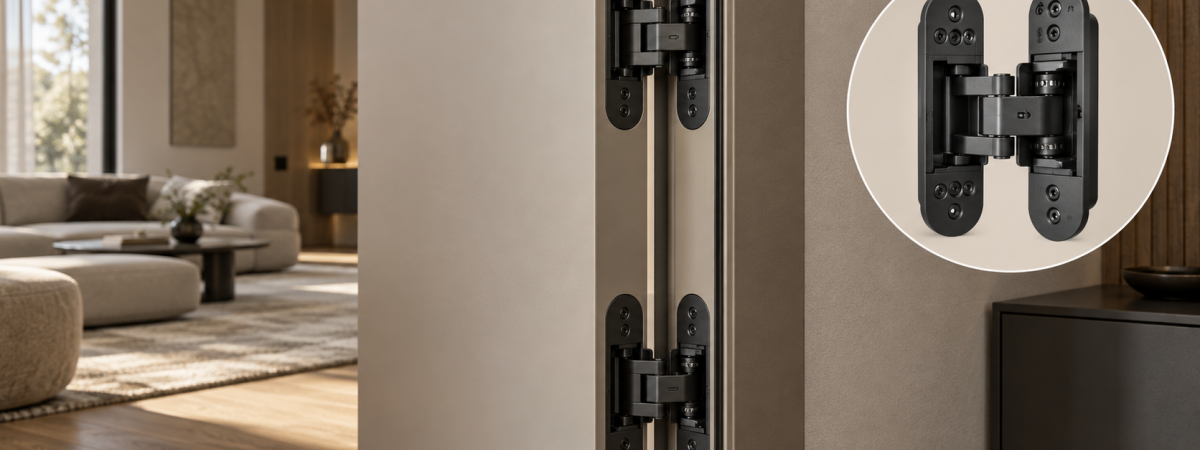
Concealed hinges are installed inside the door leaf and frame, making them practically invisible when the door is closed. They are commonly used for contemporary interior doors and concealed-frame door systems.
Here is how concealed hinges work, what their advantages are and what should be considered before ordering a door.
How do concealed hinges work?
One part of the hinge is recessed into the edge of the door leaf, while the other is installed inside the frame. Precise pockets must be milled in both components before installation.
When the door opens, the articulated mechanism unfolds and allows the leaf to move. When the door closes, most of the mechanism is concealed inside the construction.
Unlike conventional surface-mounted hinges, concealed hinges do not remain visible on the closed door.
Advantages of concealed hinges
Clean appearance
The mechanism does not interrupt the clean lines of the door. This makes concealed hinges particularly suitable for minimalist interiors and doors with concealed aluminium frames.
Adjustment possibilities
Many concealed hinge models can be adjusted in three directions:
vertically;
horizontally;
by changing the pressure or depth of the leaf relative to the frame.
This makes it possible to align the gaps around the door leaf. The exact adjustment range and procedure depend on the selected hinge model.
Suitable for flush doors
Concealed hinges are frequently used with non-rebated doors, where the leaf and frame form a visually even surface.
Compatible with concealed-frame doors
In a concealed door system, the hinges form an essential part of the complete construction. When the door is closed, only the leaf and a narrow, even gap around its perimeter remain visible.
How many hinges are required?
The correct number depends on the height, width, weight and construction of the door leaf.
A standard interior door may use two or three concealed hinges. Tall, wide, heavy, glazed or reinforced leaves may require additional hinges or a model with a higher load capacity.
The quantity should always be selected according to the technical requirements of the door and hinge manufacturers.
Can concealed hinges be fitted to any door?
Not always. The door leaf and frame need a suitable construction and sufficient material thickness. Accurate milling is also required for the particular hinge model.
Hinges from different manufacturers may have different case dimensions, installation depths and mounting positions. A door prepared for one model may not accept another model without additional work.
For this reason, the hinges should be selected before the door is manufactured or prepared.
Are there any disadvantages?
Concealed hinges generally cost more than simple surface-mounted hinges and require more precise preparation. Incorrect milling or installation can cause uneven gaps, contact between the leaf and frame, or improper closing.
Adjustment must also be performed carefully and in the correct sequence. Excessively tightening a single adjustment screw may place an incorrect load on the mechanism.
A properly selected and installed quality hinge provides stable and comfortable door operation.
Concealed or conventional hinges?
Conventional hinges are a practical and affordable choice for traditional doors. Concealed hinges are preferable when contemporary design, an invisible mechanism and precise adjustment are important.
When ordering PROFDOORS interior doors, our specialists will select suitable hinges based on the dimensions, weight and construction of the leaf. The magnetic lock, handles and other door hardware can also be coordinated before production begins.