-36x36.jpg)


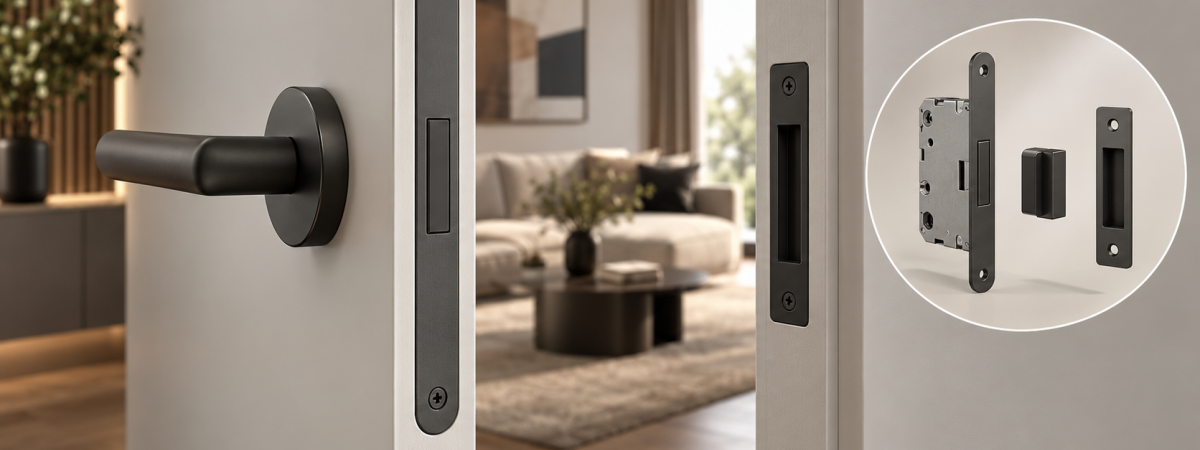
Magnetic locks are increasingly used in modern interior doors. They have a clean appearance, operate smoothly and do not leave a latch bolt protruding from the edge of an open door. Here is how the mechanism works and what you should consider before ordering it.
How does a magnetic lock work?
A conventional interior door lock uses a spring-loaded latch bolt. The bolt constantly protrudes from the lock case and enters the strike plate when the door closes.
A magnetic lock works differently. While the door is open, the latch remains inside the lock case. When the door approaches the frame, a magnet pulls the latch towards the strike plate and secures the door in the closed position.
Pressing the handle retracts the latch into the lock case, allowing the door to open.
Advantages of a magnetic lock
Clean appearance
When the door is open, the latch is concealed inside the lock. There is no permanently protruding metal component on the edge of the door leaf.
Smooth closing
The magnetic mechanism engages when the door is almost fully closed. With correct installation, this provides smooth and comfortable operation.
Less contact with the door frame
The protruding latch of a conventional lock may touch the strike plate or frame as the door closes. A magnetic latch extends only when it is aligned with the magnetic strike plate.
Suitable for modern interiors
Magnetic locks work particularly well with minimalist doors, concealed frames and contemporary door hardware.
Can a magnetic lock be locked?
Yes. A magnetic lock can provide more than simple door retention.
A key-operated model can be selected for a bedroom or office. Bathrooms and toilets commonly use a lock with a privacy turn. These sets usually provide an emergency release option from the outside.
The exact configuration depends on the selected lock, handle and intended use of the room.
What should be considered?
Correct installation is essential. The lock case and strike plate must be accurately aligned. If the door frame is uneven or the door leaf changes position, the mechanism may not operate correctly.
Locks from different manufacturers can also have different dimensions, mounting points and designs. When replacing an existing lock, check that the new mechanism is compatible with the door.
Very inexpensive hardware may operate more loudly, develop excessive movement or wear more quickly. It is therefore advisable to select a reliable mechanism designed for the particular door model.
Magnetic or conventional lock?
A conventional lock remains a practical and affordable solution. A magnetic lock is generally preferred when a modern appearance, concealed latch and smoother operation are important.
The right choice depends on the door, room, handle type and required locking function. A bathroom may need a privacy turn, an office may require a key, while a living room usually needs only a standard magnetic latch.
When ordering PROFDOORS interior doors, our specialists can help you select a compatible magnetic lock, handles and other necessary hardware. It is best to confirm the complete specification before the door is manufactured so that all openings and mounting points can be prepared correctly.